How to Sleep Deeper: A Science-Backed Guide
Introduction
You know the feeling. You crawl into bed at 10 PM, clock your full eight hours, and still wake up feeling like you were hit by a truck. It’s a frustrating cycle that leaves you dragging through your morning and relying on caffeine just to survive the day.
Here is the secret most health blogs miss: your brain doesn't care how long you were unconscious. It cares about how long you stayed in "Deep Sleep." This stage is your body’s physical repair shop—where your muscles grow, your immune system recharges, and your brain literally flushes out waste.
If you aren't hitting those deep cycles, those extra hours of light sleep won't save you.
I’m going to share a different approach. Instead of the usual "stop drinking coffee" advice, we’re going to look at the biological switches that actually trigger restorative rest. Using data from the Mayo Clinic and Harvard Health, I’ve built a protocol that helps you hack your core temperature and light exposure to force your brain into deep recovery mode. Let's get you the rest you actually deserve.
TL;DR - The Deep Sleep Cheat Sheet
Don’t have time to read the full guide? Here is your "Cheat Sheet" for forcing your brain into deep recovery tonight:
-
Flip the Temperature Switch: Your brain won't enter deep sleep until your core body temperature drops. Set your thermostat to 65°F (18.3°C) or take a warm bath 90 minutes before bed to trigger a cooling response.
-
The Light Protocol: Get 15 minutes of direct sunlight before 10:00 AM to set your biological clock.
-
Know the Stages: Deep sleep (N3) is for physical repair and growth hormone release. REM sleep is for memory and emotional processing.
-
The 24-Hour Rule: Better sleep starts in the morning. Stop caffeine by 2:00 PM and avoid heavy meals within 3 hours of bedtime.
Deep Sleep vs. REM Sleep: Why One Restores Your Body and the Other Your Mind
I want you to think of your sleep not as "one thing," but as two different maintenance crews that show up at your house every night. If one crew doesn't show up, the house starts to fall apart, but in very different ways.
The Physical Repair Shop (Deep Sleep Stage)
This is your N3 stage, and I call it the "Hardware Repair" phase. When you are in deep sleep, your body is at its busiest. This is the only time your brain releases a massive wave of growth hormone—the stuff that actually repairs your skin, builds muscle, and fixes your bones.
But here is the real "magic" I found in the research: your brain has its own plumbing system called the glymphatic system. During deep sleep, your brain cells literally shrink to allow cerebrospinal fluid to wash away metabolic waste—think of it as a nightly "brain wash" that clears out toxins linked to Alzheimer’s. If you skip this, you wake up feeling physically heavy and "broken."
The Mental Janitor (REM Sleep Stage)
While Deep Sleep repairs the hardware, REM (Rapid Eye Movement) is where your brain fixes the "software." I like to call this stage the Mental Janitor.
Every night, this janitor files away messy emotions and fragmented thoughts into long-term memory. This is why a "disaster" at 10:00 PM often feels manageable the next morning—your brain has literally filtered out the stress while you slept. This process is essential for sleep and mental health. Without enough REM, you become irritable, forgetful, and emotionally reactive.
| Feature | Deep Sleep (Physical) | REM Sleep (Mental) |
|---|---|---|
| Primary Job | Body repair & waste removal | Memory & emotional processing |
| Physical Sign | Slow heart rate & breathing | Rapid eye movement & paralyzed muscles |
| If You Miss It | Body aches, weak immunity, fatigue | Brain fog, mood swings, poor memory |
The "Sleep Switch": The Science of Core Body Temperature
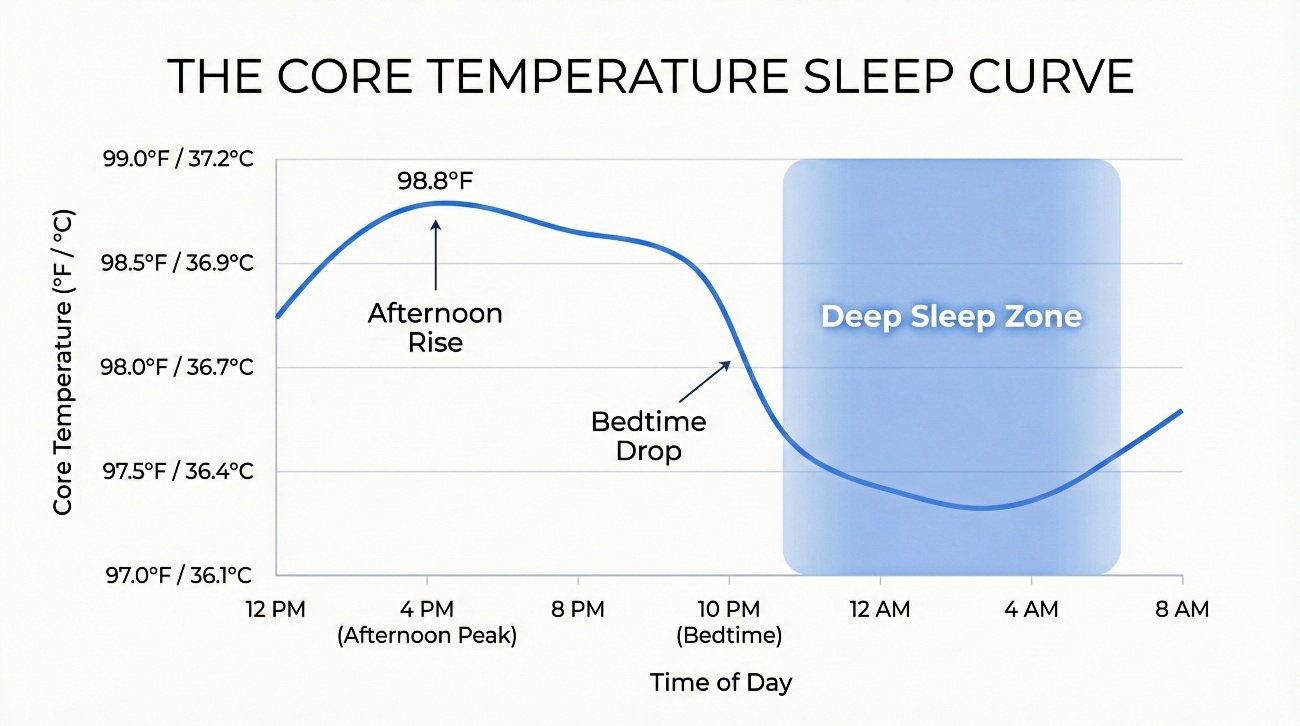
If you want to flip your brain’s "sleep switch" to ON, you have to look at your thermostat. Your body has a natural 24-hour rhythm where your temperature peaks in the late afternoon and begins to drop as bedtime approaches.
Why Cooling Down Triggers Your Brain's Sleep Mode
This drop in core temperature is a biological signal. When your core temperature dips, it tells your brain to stop producing alertness hormones like cortisol and start shifting into deep, restorative N3 sleep.
Think of it as an invitation for your brain to "power down." Research from the Mayo Clinic suggests that the optimal sleeping temperature is around 65°F (18.3°C). If your room stays too warm, that switch stays stuck in the "OFF" position.
The Warm Bath Paradox (Compensation Heat Loss)
This brings us to a trick that seems like a mistake: the warm bath. When you soak in warm water, your body sends blood to the surface of your skin to try and cool you down. When you step out of the bath, all that heat radiates away rapidly through your hands and feet. This "rebound" cooling causes your core temperature to plummet, essentially tricking your brain into thinking it is time for deep recovery.
The 24-Hour Deep Sleep Protocol
High-quality rest is a 24-hour biological process. What you do at 8:00 AM directly determines how much growth hormone you release at 2:00 AM.
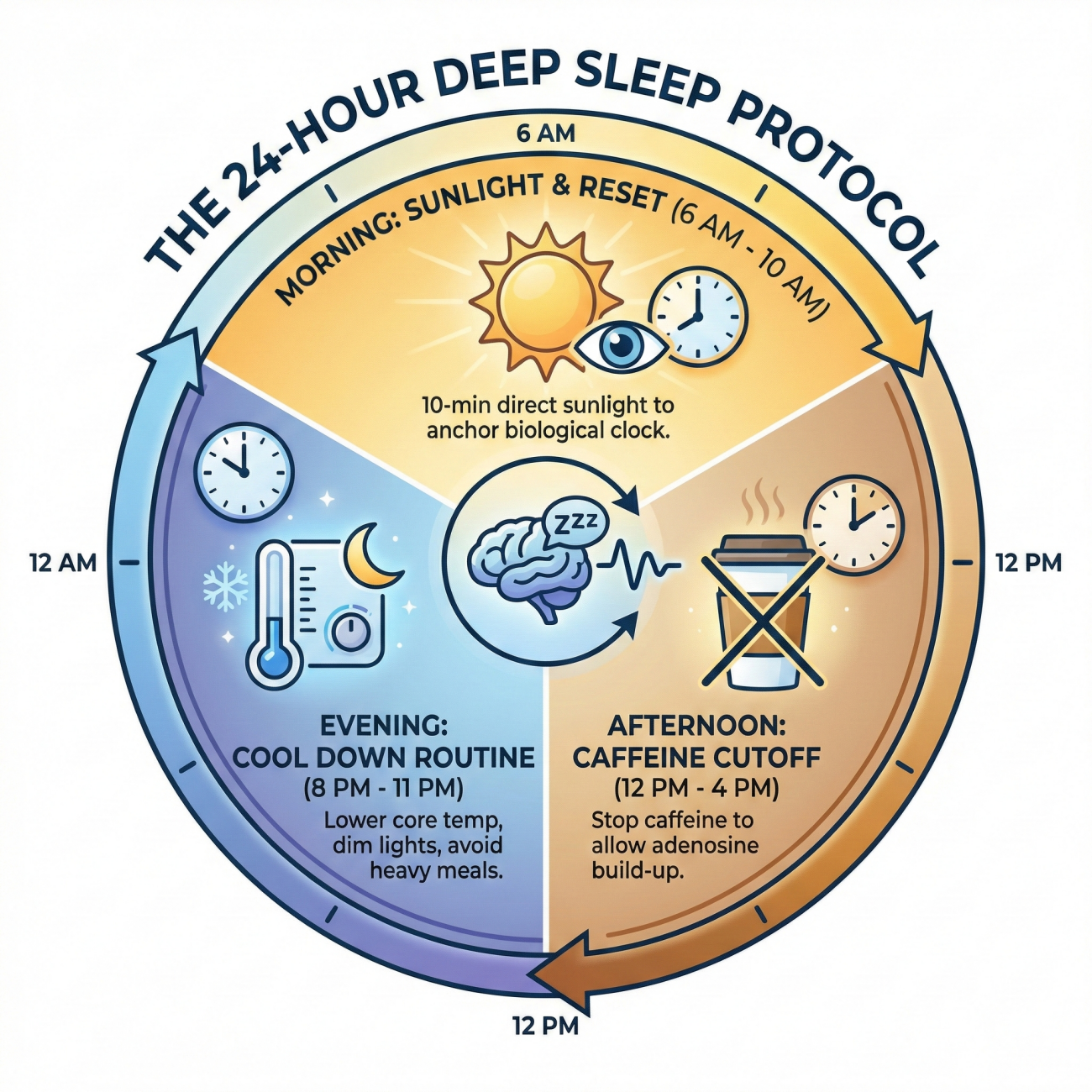
Morning: Setting Your Biological Clock with Sunlight
Your circadian rhythms are controlled by light.
-
The 10-Minute Sun Rule: Try to get direct sunlight into your eyes within 30 minutes of waking.
-
The Cortisol Spike: Early light exposure triggers cortisol, which acts as a timer for your brain to start producing melatonin—the sleep hormone—about 14 hours later.
Afternoon: The Caffeine and Blue Light Cutoff Lines
-
The Caffeine Half-Life: Caffeine blocks adenosine, the chemical in your brain that creates "sleep pressure". Even if you feel tired, caffeine stays in your system for 8 hours, preventing N3 cycles. I recommend a strict cutoff by 2:00 PM.
-
The Blue Light Trap: Dim indoor lights after sunset. Artificial blue light mimics the sun and tricks your brain into thinking it is still noon.
Evening: The Precision Cool-Down Routine
-
The 65°F Standard: As mentioned, keep your room cool. If it is too hot, your body struggles to dump the heat necessary for deep recovery.
-
Stop the "Heavy Lifting": Avoid heavy meals or high-intensity exercise within 3 hours of bedtime, as both raise your core temperature.
Troubleshooting: What to Do if You’ve Tried Everything
I see this all the time on forums like Reddit: people have the perfect room and stop coffee at noon—yet they still wake up tired. If this is you, you are likely in a state of Hyperarousal. Your nervous system is stuck in "fight or flight" mode.
Try the Physiological Sigh:
Inhale deeply through your nose, take a second short inhale to fully inflate the lungs, then exhale slowly through your mouth. Doing this 3 times tells your brain, via the vagus nerve, that you are safe, allowing it to transition into deep recovery mode.
Conclusion & CTA
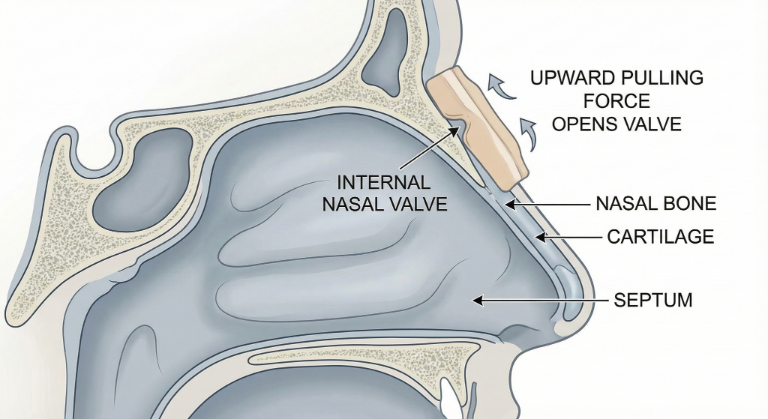
Deep sleep is the physical repair shop for your body and the "software" cleanup for your brain. We’ve talked about temperature and light, but there is one final switch people often overlook: Oxygen. If you are struggling to breathe through your nose at night, your brain stays in a state of low-level alarm. This is consistent with clinical data on the benefits of nasal breathing during sleep, which shows that ensuring clear airways is the final step to unlocking restorative cycles.
My advice? Start small. Pick one protocol—like cooling your room to 65°F—and ensure your oxygen intake is optimized. When you eliminate the 'struggle' to breathe, you unlock the door to the deepest recovery cycles.
Next Step: Ready to stop struggling with nighttime congestion? [Explore our professional Nasal Strips here] and see how clear breathing can transform your recovery tonight.